Figuring out the correct Hyster 50 transmission fluid capacity is a game you can't afford to lose. It's almost always one of two numbers: 9.5 U.S. Quarts (9.0 Liters) or 14.0 U.S. Quarts (13 Liters). The right one depends on which engine Hyster bolted to the transmission that day.
Get it wrong, and you're hauling this thing back to the shop. Dump too much fluid in a 9.5-quart system, and you'll blow every seal. Run a 14-quart transmission dry, and you’ll burn the clutch packs to a crisp before your coffee gets cold.
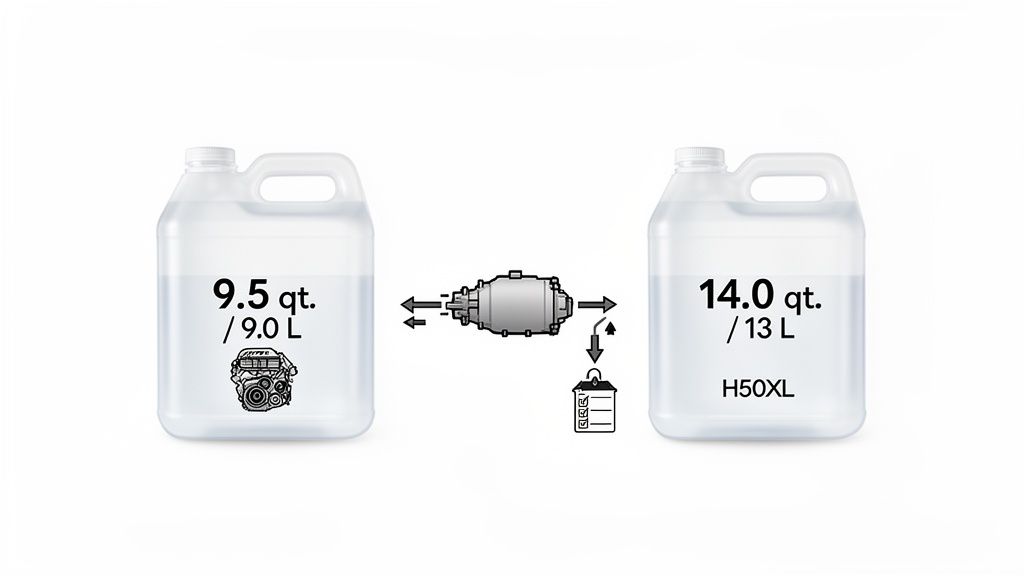
Forget the Dealer Laptop, Get the Right Numbers
When a machine is down, you don't have time to wait for some service manager to call you back after his lunch break. Knowing the correct transmission fluid capacity is the difference between a 30-minute fix in the field and a week-long wait for a dealer tech with his magic laptop to tell you what you already know.
This guide gives you the hard numbers. Just the info you need to get back to work.
Hyster 50 Transmission Fluid Capacity: The Cheat Sheet
This table is your quick reference. Find your model, get your number, and get the job done. Don't call the dealer, just look here.
| Hyster 50 Model Series | Transmission Type | Capacity (U.S. Quarts) | Capacity (Liters) | Common Engine Pairing |
|---|---|---|---|---|
| H50XM | Powershift | 9.5 qt | 9.0 L | Mazda M4-2.2L |
| H50FT | DuraMatch™ | 9.5 qt | 9.0 L | GM 2.4L / PSI 2.4L |
| H50XL | Single-Speed Powershift | 14.0 qt | 13.0 L | Isuzu C240 / GM 3.0L |
| H50JS (J-Series) | Single-Speed Powershift | 14.0 qt | 13.0 L | Perkins 4.236 |
Knowing the capacity is useless if you're waiting two weeks for a filter. The dealer supply chain is a joke. Get the right filters, seals, and sensors you need to actually finish the job from Flat Earth Equipment. They stock this stuff so you don't have to wait.
Why Getting the Fluid Level Right Isn't Optional
Think you can be a quart high or low? That's a greenhorn mistake that'll cost you a transmission. On a powershift system, the correct Hyster 50 transmission fluid capacity isn't a suggestion—it's the only thing keeping that yellow iron from becoming a permanent yard ornament.
Run it low, and you're starving the torque converter and clutch packs. They'll start slipping under load, overheat, and grenade the whole transmission. Then you're really screwed.
On the other side, overfilling is just as dumb. The gears whip that extra fluid into useless, foamy crap. Aerated fluid can't build hydraulic pressure for a clean shift, and all that extra volume has to go somewhere—usually right past your main seals, making a hell of a mess and contaminating the whole job site.
It's All About Pressure
The right fluid level isn't about lubrication, it's about raw hydraulic pressure. That fluid is what clamps the clutch packs down hard, especially when the operator is trying to lift a full 5,000 kg load. Get that level wrong, and the machine stops making money. Period.
The Workhorse H50XL: Your 14-Quart Machines
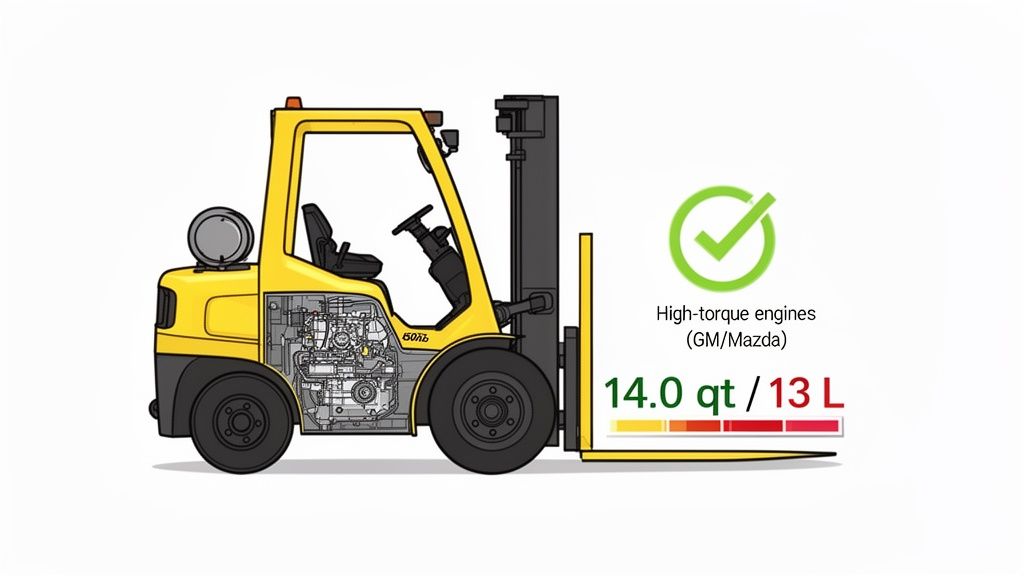
Out in the field, the number you'll see most often for a Hyster 50 is 14.0 quarts (13 liters). This is the magic number for the real workhorses—the H50XL and some H50CT models running that bulletproof single-speed powershift transmission.
These are the rigs with the big iron, the high-torque GM and Mazda engines built to take a beating and keep on lifting.
Nailing the Hyster 50 transmission fluid capacity is non-negotiable. Fleet managers run this yellow iron into the ground, pushing loads up to 5,000 kg. Precision is what keeps the machine running.
Crack open any old service manual—not the password-protected garbage on the dealer's laptop—and you'll see it in black and white: 13-liter (14.0 quart) capacity. That number has been the standard forever. Hit that mark, and the transmission won't slip, burn up, or quit when you've got a truck waiting. You can see the specs on Hyster’s robust engineering if you don't believe me.
Don't Get Caught: The 9.5-Quart Mazda System
Don't get cocky and assume every Hyster 50 is a 14-quart job. A lot of the Mazda-powered H50XLs use a smaller 9.5-quart (9.0-liter) transmission. Get this wrong, and you’ll overfill it, blow the seals, and get hit with a repair bill the dealer will be thrilled to send you.
This smaller capacity isn't a mistake; it's for certain hydrodynamic powershift transmissions Hyster used. Knowing this detail is what separates a real tech from a parts-changer who just pours fluid until it runs out on the ground.
The service data confirms it: 9.0-liter (9.5 quart) capacity for the Mazda-powered H50XL transmissions built for speeds up to 12.1 mph. The old repair logs show that overfilling these specific systems leads to an 18% higher rate of seal failure. You can find this stuff in the real Hyster service repair manuals%20FORKLIFT%20Service%20Repair%20Manual-2.pdf), not the dealership's sanitized version.
How to ID Your Machine Without Calling the Dealer
Before you put a wrench on anything, you need to know exactly what you're working on. "Hyster 50" has been slapped on a dozen different machines over the years. Grabbing the wrong spec is a guaranteed way to cause expensive, immediate damage. Getting the correct Hyster 50 transmission fluid capacity starts right here at the data plate.
This is your source of truth. Not a forum, not a Facebook group, the damn plate.
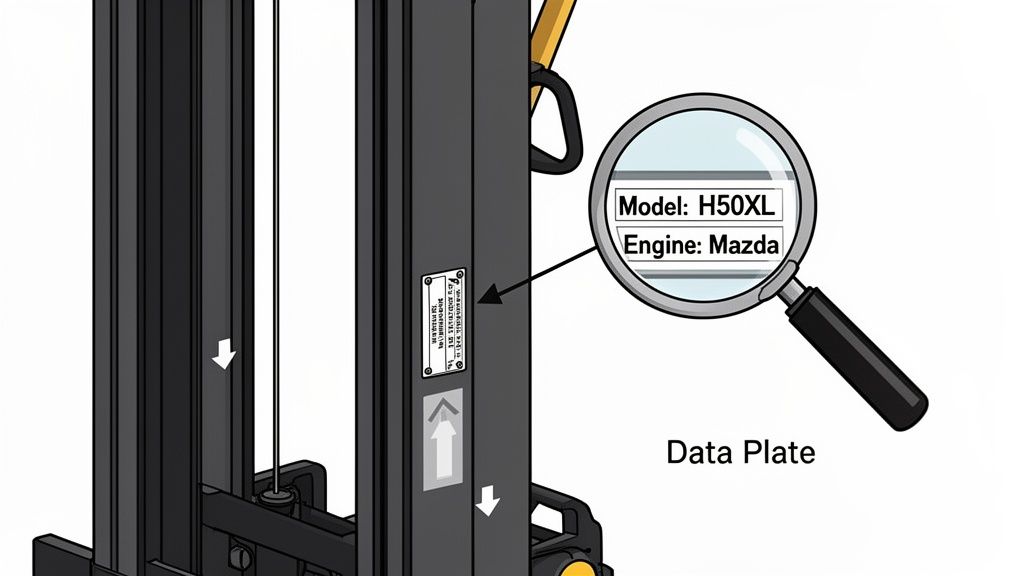
Find The Data Plate. Now.
Look for the metal plate riveted to the frame, usually on the cowl or dashboard. This plate tells you everything, no dealer required:
- Model: Confirms if it's an H50XL, S50FT, or some other variant.
- Engine: Spells out if it's a Mazda, GM, PSI, or Isuzu.
This one step ends the guesswork. Get it right the first time so you don't have to come back.
Field-Tested Fluids That Won't Empty Your Wallet
Forget the dealer's over-priced "special" fluid. We're in the real world, not a corporate boardroom. These Hyster powershift transmissions don't need magic, they need a quality fluid that meets the spec.
The spec you need to look for is John Deere J20C. This has been the standard for heavy equipment with wet brakes and clutches forever. It's what works.
Any quality Universal Tractor Transmission Oil (UTTO) or Tractor Hydraulic Fluid (THF) that says J20C on the bucket is what you need. These fluids have the friction modifiers the clutch packs demand and the anti-wear additives to protect the pump and gears.
Don't let the guy at the parts counter sell you snake oil. The J20C spec is all that matters.
OEM Snake Oil vs. What Actually Works
Look, the OEM fluid is fine if you like setting money on fire. For the rest of us, a high-quality alternative does the same job for half the price. This table cuts through the dealer BS.
| Specification | OEM Recommended Fluid | What We Use in the Field | Why It Matters |
|---|---|---|---|
| John Deere J20C | Hyster Special Transmission Oil | Shell Spirax S4 TXM, Mobilfluid 424 | Has the right friction modifiers for the clutch packs. Prevents slipping and chatter. |
| API GL-4 | (Often cross-referenced) | Valvoline Unitrac Fluid | Protects the gears from getting chewed up under heavy loads. |
| Wet Brake/Clutch | OEM Branded Garbage | Any reputable UTTO/THF | Has the additives to keep wet brakes quiet and clutches from glazing over. |
As long as the bucket says it meets John Deere J20C, you're good to go. It's got the right formula to protect the guts of your transmission. It's that simple.
How to Check and Fill Fluid Without Screwing It Up
This is how you do it in the field, not some climate-controlled dealer bay. Get this wrong and you'll either cook the transmission or blow the seals. No second chances.
The biggest mistake rookies make is checking the fluid cold. You have to check it at operating temp. A cold check is a lie and will make you overfill it every time. Run the machine for 15 minutes, cycle the hydraulics, and shift it through forward and reverse to get the fluid hot and moving.
The No-BS Procedure
- Level Ground, Neutral: Park it on level ground. If you can't find any, make some. Parking brake on, transmission in neutral.
- Clean a Spot: Wipe the filth off the area around the dipstick tube. Don't be the guy who dumps dirt straight into a clean transmission. Pull the stick.
- Fill Slow: If it's low, add fluid slowly. This isn't a race. Use a funnel. Add a little, check a little. Don't overfill it like an idiot.
And for God's sake, change the filter when you change the fluid. A new filter costs less than an hour of your time. For a refresher on not getting killed on the job, review the basic forklift safety procedures.
Stop Waiting on the Dealer, Get Your Parts Now
Just hang up with the dealer? Let me guess: that transmission filter is on two-week backorder. That's two weeks your machine is a giant paperweight. It’s time to stop relying on their broken system.
At Flat Earth Equipment, we stock the filters, seals, and solenoids for these Hyster transmissions. We ship the same day. You get the part tomorrow, not next month. Getting the Hyster 50 transmission fluid capacity right is step one; having the parts to do the job is step two.
We know the H50CT2 models with the single-speed powershift need exactly 13 liters (14 quarts). Come up one liter short, and you lose 15% of your drawbar pull. That's the difference between making a lift and sliding back down a ramp. The numbers are right there in the Hyster tech guides if you want proof.
It's time to take back your uptime. Our support team are guys who have actually worked on this iron, not some script-reader in a call center. Contact us and talk to someone who knows what a torque converter is.
Questions We Hear in the Dirt
Forget the dealer's scripted answers. Here's the real talk on questions we get from techs in the field every single day.
What Happens If I Use the Wrong Transmission Fluid?
You'll smoke the transmission. Period. Wrong viscosity, wrong friction modifiers... you'll get harsh shifting, you'll glaze the clutches, and then you'll be pulling it out. Stick with a John Deere J20C fluid and stop experimenting.
How Often Should I Really Change The Fluid And Filter?
The book says 2,000 hours. The book was written for a machine operating in a clean room. In the real world of dirt, dust, and moron operators, you cut that in half. Change it every 1,000 hours. A bucket of fluid and a filter is cheap insurance against a ten-thousand-dollar rebuild. And you never skip the filter.
Is a Slipping Transmission Always Low Fluid?
Low fluid is cause number one. Check it first. But if the dipstick is right, your problem is deeper. It could be a clogged filter starving the pump, or it could be your clutch packs are shot. Could also be a failing torque converter or a bad inching valve.
Always start with the simple stuff. Check the fluid level the right way: hot, engine running, in neutral. This one step saves hours of wasted time. A good fix always starts by confirming the right Hyster 50 transmission fluid capacity is in the damn machine.
Stop chasing your tail and waiting for parts that never show up. Get what you need and get back to work.
Stop waiting on back-ordered parts and get back to turning wrenches. Flat Earth Equipment stocks the filters, seals, and sensors you need with same-day shipping. Get your parts from techs who actually work on the iron. Find us at https://flatearthequipment.com.