Ready to get behind the controls of a forklift? The path to becoming a certified operator is clear and direct, but it's not quite like getting a standard driver's license. There's no single, government-issued "forklift license." Instead, your qualification is a combination of formal OSHA-compliant training and a final, hands-on certification from your employer.
To kick things off, you must be at least 18 years old. From there, you'll complete a training program that covers both classroom theory and practical driving skills. Finally, you’ll be evaluated and certified by your employer on the specific forklift models you'll be using day-to-day.
Your Roadmap to a Forklift Operator Career
Think of this journey as building your skills from the ground up. You'll move from a total novice to a confident, skilled professional who’s a major asset in any warehouse, manufacturing plant, or construction site.
It all comes down to meeting federal requirements, mastering the machine, and proving you can operate it safely. Employers aren't just looking for a piece of paper; they want to see a genuine commitment to safety protocols. That commitment starts the moment you begin training and carries through every single pre-shift inspection you'll ever do.
Key Milestones on Your Path to Certification
Your journey really boils down to three core phases. First, you meet the basic legal requirements. Next, you get formal training covering the "why" (theory) and the "how" (hands-on driving). The final step is getting the official sign-off from your employer after they've evaluated you on their equipment.
This visual breaks down the simple, step-by-step flow of the process.
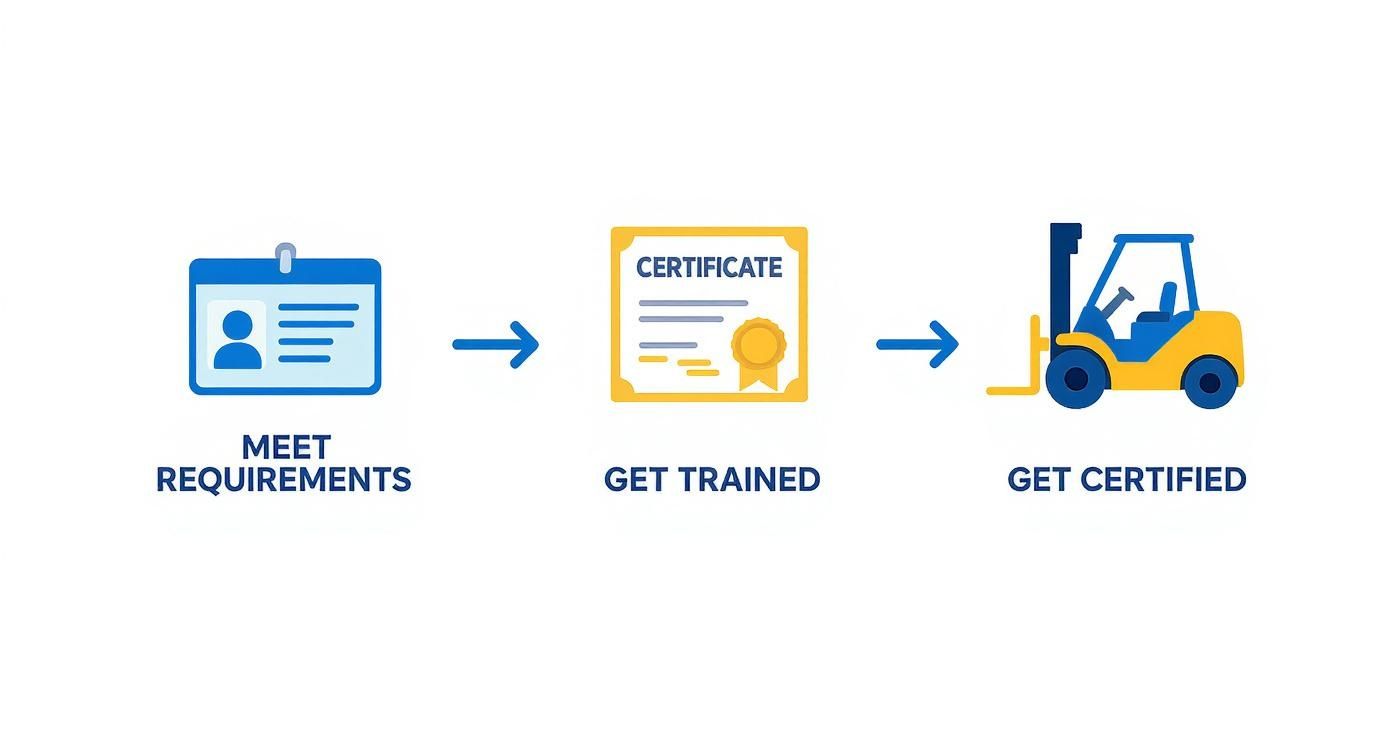
As you can see, each stage builds on the one before it. This ensures you have a solid foundation of both knowledge and practical skill before you start moving loads.
To give you a clearer picture, here's a quick breakdown of what to expect at each stage of your certification journey.
Forklift Operator Certification At a Glance
| Milestone | Key Requirements | Typical Duration |
|---|---|---|
| Meet Prerequisites | Must be at least 18 years old. Have the physical ability to operate machinery safely. | Immediate |
| Complete Formal Training | Pass classroom/online instruction on OSHA safety standards. Complete hands-on driving practice. | 4-8 hours |
| Pass the Evaluation | A certified trainer observes you operating a forklift, assessing your skills and safety awareness. | 1-2 hours |
| Receive Employer Certification | Your employer provides final, equipment-specific authorization to operate their forklifts on-site. | Varies by employer |
This table maps out the entire process, showing how each step logically leads to the next, culminating in you being a fully authorized operator.
Understanding this roadmap from the start sets you up for success. It’s not just about learning to drive—it’s about becoming a responsible, safe, and indispensable part of the team.
Key Takeaway: Your initial training certificate gets your foot in the door, but it is your employer who provides the final, site-specific certification that officially authorizes you to operate their forklifts. This distinction is critical and often misunderstood by new operators.
Meeting OSHA Requirements and Eligibility
Before you even think about hopping on a lift, you need to know the ground rules. These aren't just company policies; they're federal laws from the Occupational Safety and Health Administration (OSHA) designed to keep everyone in one piece. Your path to becoming a certified operator starts right here, with the basic legal and eligibility standards.
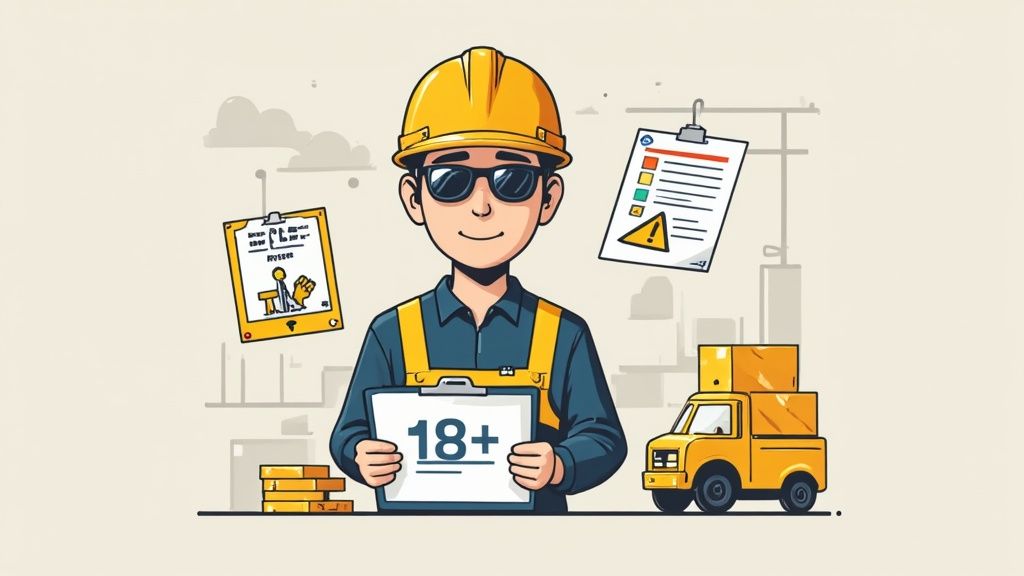
First thing's first: age. Federal law is crystal clear on this one—you must be at least 18 years old to operate a powered industrial truck. That category includes every forklift out there, from a small pallet jack to a massive telehandler. Forklift operation is classified as a hazardous job for minors, so there are absolutely no exceptions.
Unpacking OSHA Standard 29 CFR 1910.178
Beyond your age, the entire world of forklift training and safety is built around one critical regulation: OSHA standard 29 CFR 1910.178. This isn't just government red tape; it's the rulebook for forklift operators.
The most important takeaway from this standard is that every operator has to be trained and certified on the specific type of forklift they'll be using at their job. A certificate you get from a training school is a great starting point, but it's not the final step. Your employer provides the official, site-specific certification after they’ve watched you operate their equipment in their facility.
Crucial Insight: The law puts the final responsibility for certification squarely on the employer. A training certificate shows you've learned the material, but only your employer can officially sign off on you to operate their specific lifts after a hands-on evaluation.
Do You Have the Right Physical Abilities?
Operating a forklift is a lot more demanding than driving your car. It requires a solid set of physical skills to work safely and efficiently, especially over an eight-hour shift. While OSHA doesn't mandate a specific medical exam, any good employer will evaluate if you're physically up for the job.
You'll absolutely need:
- Good Vision: Having solid depth perception is key to judging distances and navigating aisles without clipping a rack.
- Adequate Hearing: You have to be able to hear horns, alarms, and people shouting warnings in a noisy warehouse or yard.
- Coordination: Great hand-eye coordination is non-negotiable for manipulating the controls to lift and place heavy loads precisely where they need to go.
- Physical Stamina: The job involves sitting for long stretches, dealing with vibrations, and often climbing in and out of the cab all day.
These aren't just suggestions—they are fundamental requirements for safe operation. For a closer look at what's expected on the job, our guide to forklift safety has some great insights.
The Formal Training Mandate
Gone are the days of just learning on the job. The path to becoming a forklift operator is now a structured process designed to cut down on accidents. OSHA requires every operator to complete a certified program that includes both classroom-style instruction (formal learning) and hands-on practice (practical training).
This two-part approach makes sure you not only know the safety rules but also have the muscle memory to follow them. It's a system that works. Today, about 85% of forklift operators in the U.S. go through this formal training, a huge factor in making warehouses and job sites safer for everyone.
Choosing the Right Forklift Training Program
Picking the right training program is probably the most important decision you'll make starting your new career. This one choice separates a legitimate, employer-respected qualification from a worthless piece of paper. You'll find everything from fully online courses to dedicated, hands-on training centers, and knowing the difference is everything.
Let's cut through the noise. OSHA requires every certified operator to pass a hands-on performance evaluation on an actual forklift. This is non-negotiable.
What does that mean for you? It means any 100% online course is only half the solution. They can cover the classroom part, but they can't legally get you fully certified by themselves.
Differentiating Online Vs. In-Person Training
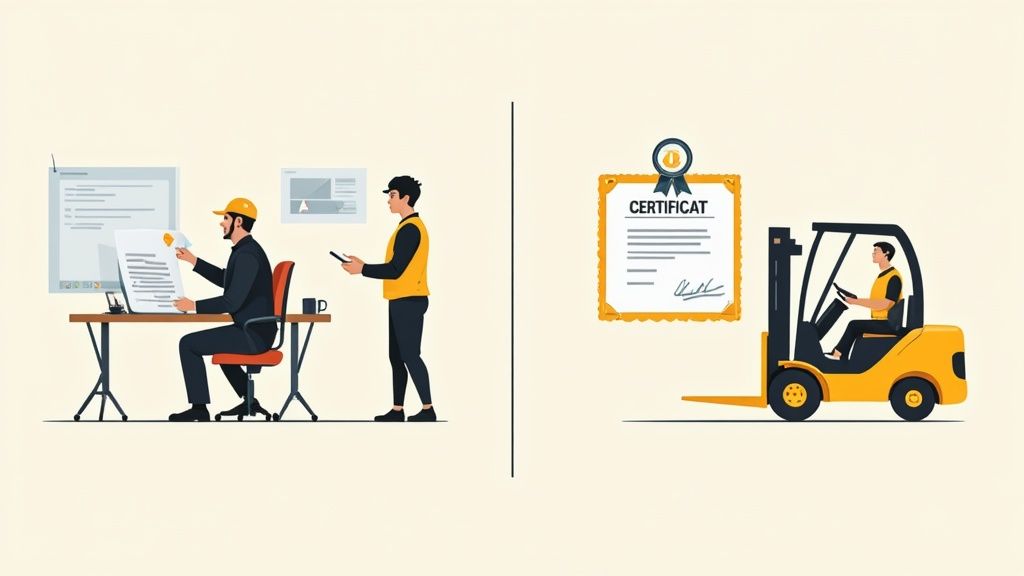
The online vs. in-person debate isn't about which is "better," but what each one accomplishes. Online programs offer amazing flexibility for learning the theory—you can study OSHA rules and safety principles whenever it fits your schedule. But that’s where they stop.
In-person training, on the other hand, gives you the whole package. You get the classroom instruction plus critical driving time on real machines, all under the supervision of an experienced instructor. There’s also a third path: a hybrid model that blends online theory with a scheduled in-person driving evaluation, offering a solid mix of convenience and compliance.
Comparing Forklift Training Formats
To help you figure out what's best for your learning style and budget, here’s a quick breakdown of how the training formats compare.
| Feature | Online Training | In-Person Training | Hybrid Model |
|---|---|---|---|
| OSHA Compliance | Covers theory only; requires separate hands-on test. | Fulfills all OSHA requirements in one package. | Fulfills all OSHA requirements through two distinct steps. |
| Convenience | Highly flexible; learn from anywhere, anytime. | Fixed schedule at a physical training center. | Flexible theory, but requires a scheduled evaluation. |
| Cost | Generally lower upfront cost for the course itself. | Higher cost but is typically all-inclusive. | Costs are split between the online course and the test. |
| Practical Skills | Zero hands-on practice included. | Direct, instructor-led practice on real equipment. | The hands-on part is just an evaluation, not extended practice time. |
The bottom line is that any quality program must lead to a practical, hands-on assessment. Any course promising "instant online certification" isn't following federal law, period.
How to Spot a Legitimate Program
With so many providers out there, you have to be a smart shopper. A real training program isn't just going to take your money and email you a PDF certificate. It will prepare you for the job and give you a credential that managers actually trust.
Here’s what to look for to avoid getting ripped off:
- Clear OSHA Compliance: The provider should explicitly state their program meets OSHA standard 29 CFR 1910.178. If they don't mention this, run.
- A Path to Hands-On Evaluation: They must either provide the in-person evaluation themselves or have a clear, established process for you to get it done with a qualified trainer.
- Real Reviews from Past Students: Look for testimonials on independent sites. Do graduates say the training helped them land a job? That’s the real test.
- Transparent Equipment Information: Does the website or brochure specify what types of forklifts you'll train on? A good school will offer training on common equipment like sit-down counterbalance lifts or stand-up reach trucks.
Asking a few direct questions can save you a ton of time and money. It's also worth looking into local requirements and trusted providers to see how quality training is structured, like these details on forklift training programs in Texas.
Expert Tip: When you call a training center, ask this exact question: "Does your program conclude with a hands-on performance evaluation conducted by a qualified trainer?" A confident "yes" is what you want to hear. If they get vague or try to dance around the answer, be very cautious.
Asking Smart Questions About the Equipment
The specific forklift you train on really matters. A warehouse that only uses narrow-aisle reach trucks won't care much if you only have experience on a sit-down forklift used at a lumberyard. The best training facilities will have several types of equipment ready for you.
Before you sign up, find out:
- What specific classes of forklifts are part of the training? (e.g., Class IV, Class V)
- Is the equipment well-maintained and similar to what's being used in local warehouses right now?
- How much actual "seat time" will you get during the practical portion of the course?
Your goal is simple: leave the program with skills that are immediately useful for your first job. Choosing a program that teaches you how to operate the machines local employers actually use is a strategic move that puts you way ahead of the competition.
Mastering the Skills for Your Forklift Evaluation
Getting through your forklift evaluation isn’t just about memorizing a few rules to pass a test. It's about showing your trainer you’ve got a rock-solid, practical grasp of safety and efficiency—skills you'll rely on every single day on the job. The evaluation is typically split into two make-or-break parts: proving your knowledge and demonstrating your driving skills.
The "classroom" part, whether you do it online or in a training room, is where it all begins. This is your chance to show you understand the why behind the rules, not just the how. You’ll be tested on the concepts that prevent the most common—and most dangerous—accidents.
Why is this taken so seriously? The numbers speak for themselves. In the U.S. alone, somewhere between 35,000 and 62,000 forklift-related injuries occur annually, and an average of 87 workers are killed each year. But here’s the crucial part: studies have shown that proper training could prevent around 70% of these incidents. Mastering these skills isn't just a box to check; it’s a career-defining responsibility.
Nailing the Classroom Knowledge
Before you even think about grabbing the keys, you have to get comfortable with the physics of a forklift. These aren’t just abstract theories; they are the principles that keep a multi-ton machine from ending up on its side.
You absolutely need to understand:
- The Stability Triangle: Think of this as the invisible three-point suspension system that keeps a forklift upright. Your trainer will expect you to explain how the center of gravity shifts as you lift a load, take a corner, or navigate a ramp.
- Load Capacity Plates: Every forklift has a data plate that is essentially its instruction manual. You must be able to read it and know exactly what it's telling you about maximum load weight, lift height, and load center.
- Center of Gravity: You'll need to explain how the forklift's center of gravity combines with the load's center of gravity. Keeping that combined point inside the stability triangle at all times is the key to preventing a tip-over.
Pro Tip: An evaluator won't just ask for a textbook definition. They’ll throw a real-world problem at you, like, "You've got a 4,000-pound pallet that's 48 inches deep. Looking at this data plate, can you safely put it on the top rack?" They’re testing your ability to apply what you know, not just recite it.
Dominating the Hands-On Driving Test
Now it’s time to put that knowledge into action. When you get behind the wheel, the evaluator is watching everything. They’re looking for more than just your ability to drive a straight line—they’re assessing your smoothness, your awareness of your surroundings, and your unwavering commitment to doing things the right way.
Your practical test will almost certainly involve these key tasks:
- The Pre-Use Inspection: You'll have to perform a thorough walk-around, checking everything from tire pressure and fluid levels to the horn and backup alarm. Don't rush it. This is the first and most important test of your safety-first mindset.
- Navigating Tight Spaces: Expect to drive through a cone course or a mock warehouse aisle, both forward and backward, without hitting a single thing.
- Picking and Placing Loads: This tests your finesse. You’ll need to smoothly approach a pallet, adjust your forks to the perfect height and width, and lift the load without any sudden jerks.
- Stacking at Height: This is often the final boss of the test. You'll have to lift a pallet and place it precisely on a high rack, showing you have complete control and understand the machine's capabilities.
The Unspoken Test: Your Daily Inspection Habit
One of the most vital habits you'll form is the pre-operation inspection. This isn't just a checklist to mindlessly tick off; it’s a critical safety ritual that protects you, your coworkers, and the equipment. During your evaluation, perform the inspection as if you’ve done it a hundred times before, touching each part and saying out loud what you're checking for.
This routine is especially critical for the machine's electrical system. For example, a quick check of the battery terminals for corrosion can be the difference between a smooth shift and a sudden power failure mid-lift. Knowing the health of your power source is non-negotiable. If you're working with an electric fleet, learning about industrial battery chargers and proper maintenance will put you ahead of the game.
When an employer sees you conduct a meticulous inspection, they don’t just see a task being completed. They see a professional, reliable operator they can trust.
How to Land Your First Forklift Operator Job
You’ve got the training certificate—now it’s time to turn those new skills into a paycheck. This is where you shift gears from being a trained candidate to a hired operator. The good news? The job market for skilled operators is strong, but you still need a solid game plan to get noticed.
First, let's clear up a common point of confusion: the difference between your training certificate and an employer's certification. The paper you earned from school proves you passed an OSHA-compliant program. But the final, official certification comes from the employer after they watch you operate their specific equipment in their work environment.
Think of it this way: your certificate gets your foot in the door. Their evaluation lets you start the engine.
Building a Resume That Gets Noticed
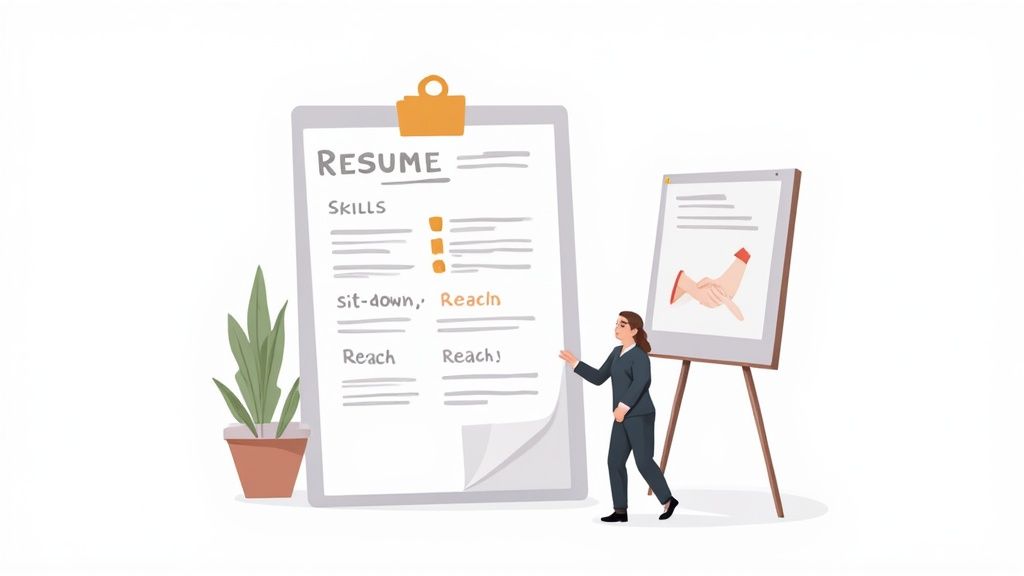
Your resume is your first handshake, and it needs to scream "safe and competent." Don't just list "forklift operator" and call it a day. Create a dedicated "Skills & Certifications" section that immediately shows a hiring manager exactly what you can do.
Get specific. Use the keywords you see in their job descriptions. Instead of a generic bullet point, detail your qualifications like this:
- Forklift Operation: Proficient in operating Sit-Down Counterbalance (Class IV & V) and Stand-Up Reach Trucks (Class II).
- OSHA Compliance: Completed OSHA-compliant training (29 CFR 1910.178), including classroom instruction and hands-on evaluation.
- Safety Protocols: Skilled in conducting daily pre-operation inspections, identifying workplace hazards, and adhering to all safety procedures.
- Load Management: Experienced in safely lifting, stacking, and transporting palletized loads up to 4,500 lbs.
This level of detail proves you understand the technical side of the job and aren't just a beginner holding a piece of paper. It paints a clear picture of your skills before you even get on the phone.
Where to Find the Best Forklift Operator Openings
It's time to start the hunt, but a targeted search is way more effective. General job boards are fine, but focusing on industry-specific resources will get you better leads, faster.
The outlook is solid. In 2023, there were roughly 870,000 forklift operator jobs in the U.S. alone, with a projected 4% annual growth rate. That shakes out to about 35,000 new openings every year. The jobs are out there if you know where to look. You can dive deeper into forklift market trends on gminsights.com to see the numbers for yourself.
Here are the best places to start your search:
- Industrial Staffing Agencies: These firms are your direct line to warehouse, manufacturing, and logistics roles. They have relationships with hiring managers and often know about jobs that never get posted publicly.
- Local Distribution Centers: Take a drive through the industrial parks near you. Big players like Amazon, FedEx, and major grocery chains are almost always hiring and often put up signs right on their property.
- Manufacturing Plants: Any facility that makes something needs people to move materials and finished products.
- Big-Box Retail and Home Improvement Stores: Places like Home Depot or Lowe's have huge backroom and garden center operations that depend on skilled forklift operators.
Insider Tip: Don't be just another online application. After you submit your resume, follow up with a polite phone call to HR or, if it feels right for the company, visit the location in person. A little bit of initiative goes a long way and makes you stand out from the hundreds of other digital resumes they get.
Acing the Interview with a Safety-First Mindset
The interview is your final test. More than anything else, the hiring manager is looking for one thing: a deep, unshakable commitment to safety. They can teach you the layout of their warehouse, but they can't teach you caution and responsibility.
Get ready for scenario-based questions. They won’t ask, "Are you a safe operator?" They'll put you on the spot with questions like:
- "What would you do if you found a hydraulic leak during your pre-shift inspection?"
- "Describe a time you had to navigate a congested area. How did you ensure everyone's safety?"
- "Walk me through your process for handling a load that you suspect might be unstable or too heavy."
Your answers should always come back to three things: protocol, communication, and caution. Talk about stopping work, reporting the issue to a supervisor, and never taking a risk.
Emphasizing your methodical approach to inspections and your constant awareness of your surroundings will impress them way more than talking about how fast you can move pallets. Proving you're a low-risk hire is the single most important thing you can do to land that first forklift operator job.
Advancing Your Career Beyond the Warehouse Floor
Getting your forklift certification is a huge first step, but it’s really just the starting line. Think of that operator card less like a diploma and more like a professional license—it’s something you have to maintain to keep it valid. This commitment is what turns a forklift job into a real, long-term career in the supply chain world.
The baseline for this is keeping up with federal rules. OSHA is pretty clear that employers need to re-evaluate every operator's performance at least once every three years. This isn't about going back to square one; it's a practical check-in to make sure your skills are still sharp and you’re operating safely. It’s like a professional tune-up.
Staying Current and Compliant
But you won't always wait three years. Certain situations on the job will trigger an immediate need for retraining. It's all about keeping you and your coworkers safe.
An employer has to provide more training if an operator:
- Is involved in an accident or even a near-miss.
- Is seen operating a forklift in an unsafe way.
- Gets assigned to a totally different type of truck or a new work environment.
- Receives a poor performance evaluation.
This isn't a punishment. It's a system designed to catch bad habits before they become dangerous, reinforcing a culture of safety that everyone benefits from.
Career Insight: Don't look at recertification as a chore. See it as a chance to polish your skills. Managers absolutely notice the operators who stay on top of their credentials without being reminded—those are the people who get considered first for new responsibilities or promotions.
Exploring Advanced Career Paths
Once you’ve truly mastered the forklift, you’ll find it opens up a surprising number of doors. You’re not just a driver; you have a deep, practical understanding of how a warehouse breathes—product flow, safety protocols, and efficiency. That experience is incredibly valuable.
Many skilled operators decide to specialize. Becoming the go-to expert on complex machines like Very Narrow Aisle (VNA) trucks or high-capacity telehandlers can seriously boost your paycheck and put you in a more specialized role. These machines demand a high level of precision, and companies pay well for operators they can trust.
Alternatively, you can leverage that on-the-floor experience into a leadership position. I've seen countless great operators move up into roles like:
- Lead Operator or Team Lead: You'd be supervising a shift, coordinating tasks, and making sure your team hits its goals safely.
- On-Site Trainer: Take your real-world knowledge and use it to train the next wave of new hires. You become a critical part of your company’s safety program.
- Inventory Control Specialist: Instead of just moving pallets, you'd be managing them. Your firsthand experience helps improve inventory accuracy and efficiency in ways someone who has only worked in an office can't.
- Logistics or Dispatch Coordinator: This moves you into the office, where you'll help plan and manage how goods move through the entire supply chain.
Your journey on how to become a forklift operator doesn't stop when you get that card. It's where it begins. Every single shift is a chance to build the expertise you'll need for whatever comes next.
Common Questions About Forklift Certification
Even with a clear path forward, you've probably got a few lingering questions. Let's tackle the ones that pop up most often for new operators. Getting straight answers now is the best way to plan your next move and make sure you're investing your time and money smartly.
How Much Does Forklift Training Actually Cost?
The first question is always about the bottom line. What's the real cost? You can expect to see forklift training prices ranging anywhere from $150 to $350.
A lower-cost course might just cover the online theory part of the equation. On the other hand, a higher-priced, all-in-one program will bundle the classroom instruction, hands-on driving practice, and the final evaluation into a single package.
Can You Get Hired Without Experience?
This is the classic chicken-and-egg problem, but for forklifts, the answer is a definite yes. While having some warehouse experience is always a nice bonus, your training certificate is your golden ticket. It's solid proof to an employer that you’ve already invested in learning the foundational safety and operational skills required by OSHA.
Key Insight: Think of your training certificate as your "Day One" experience. It tells a hiring manager you’re a low-risk candidate who already gets the principles of safe operation, making you way more appealing than someone with zero training.
Many employers are perfectly willing to hire certified but inexperienced operators. Why? Because they can train you on their specific equipment and workflow from the ground up. Your certificate gets your foot in the door; your can-do attitude and focus on safety during their on-the-job evaluation will land you the job.
How Long Does Forklift Certification Last?
Your forklift certification isn't a "one and done" deal. According to OSHA, your employer needs to re-evaluate your performance at least once every three years to make sure your skills are still sharp.
But don't get too comfortable. Certain events can trigger an immediate need for retraining well before that three-year mark hits. This could be anything from being involved in an accident or a near-miss, getting spotted operating the lift unsafely, or being assigned to a completely different type of truck.
What Industries Hire Forklift Operators?
When you picture a forklift, a massive warehouse is probably the first thing that comes to mind. But the job opportunities are so much broader than just stacking pallets in a distribution center. Skilled operators are in high demand across a ton of different industries:
- Manufacturing: Moving raw materials to the production line and getting finished goods ready for shipment.
- Big-Box Retail: Managing inventory in the backrooms and garden centers of places like Home Depot or Lowe's.
- Construction: Lifting and shifting heavy building materials around active job sites.
- Lumber Yards and Stone Suppliers: Handling bulky, awkward loads that require real skill and precision.
Learning to operate a forklift opens doors in pretty much any sector that deals with moving physical products.
Ready to get your certification journey started? Flat Earth Equipment offers a fast, affordable, and OSHA-compliant online training program you can knock out in just a few hours. Get your QR-verifiable certificate today at https://flatearthequipment.com.