Proper forklift operator safety training isn't just about checking a box for OSHA—it’s the single most effective way to prevent accidents, protect your team, and keep your operation running smoothly. Think of it as a fundamental investment in the safety and productivity of your entire workplace.
A well-designed program blends essential classroom knowledge with practical, hands-on practice, turning inexperienced staff into competent, confident operators.
Why Effective Forklift Training Is Non-Negotiable
When we move past the standard 'safety first' slogans, the real-world impact of forklift operations becomes crystal clear. The hard numbers and human stories behind forklift incidents show why robust training is one of the most critical investments a business can make. It's often the only thing standing between a smooth, profitable operation and a costly, dangerous one.
A comprehensive program does more than just slash accident rates. Properly trained operators are more efficient, cause far less damage to expensive equipment and inventory, and help build a stronger safety culture from the ground up. This proactive approach saves money and, more importantly, it saves lives.
The Real Cost of Forklift Incidents
The statistics below paint a stark picture of what happens when training is overlooked. These aren't just abstract figures; they represent real people, real families, and real financial consequences for businesses.
| Statistic | Figure/Impact |
|---|---|
| Annual Fatalities (U.S.) | Average of 87 deaths per year. |
| Growth in Fatalities | A nearly 30% increase in recent decades. |
| Non-Fatal Injuries (2017) | 9,050 incidents reported by the U.S. Bureau of Labor Statistics. |
| Lost Work Time | A median of 13 days away from work per incident. |
Source: U.S. Bureau of Labor Statistics
These numbers quickly translate into tangible, and often devastating, business costs that go far beyond the initial incident.
When Training Fails, The Costs Add Up
When training is inadequate, the consequences are severe. Those statistics aren't just numbers on a page; they represent real costs that can cripple a business:
- Skyrocketing Workers' Comp: After an incident, your insurance premiums can increase dramatically, affecting your bottom line for years to come.
- Costly Operational Downtime: A single accident can halt production for hours, if not days, leading to missed deadlines and lost revenue.
- Equipment and Product Damage: One collision can result in thousands of dollars in forklift repairs and destroyed inventory.
- Steep Legal and Regulatory Penalties: Failing to meet OSHA standards can bring substantial fines and legal action, creating a massive financial and reputational headache.
The true cost of an accident is never just the immediate damage. It’s a ripple effect of lost productivity, damaged morale, and long-term financial strain that a proactive training program is designed to prevent.
Building a Foundation for a Resilient Operation
Investing in quality forklift operator safety training transforms a simple requirement into a cornerstone of a resilient and profitable business. It empowers your team with the skills to spot hazards, handle loads correctly, and perform daily inspections that catch small issues before they become catastrophic failures.
This focus on prevention creates a workplace where employees feel valued and protected. When operators are confident in their training, they perform their jobs more effectively and safely.
For more insights on creating this environment, explore our detailed guide on essential forklift safety practices. Ultimately, a compliant and thorough training program isn't an expense—it's a strategic investment in your people, your equipment, and your company's future.
Decoding OSHA's Forklift Training Requirements
Navigating OSHA's rules can feel like digging through a legal maze, but when it comes to forklift training, the requirements are crystal clear. The federal standard, 29 CFR 1910.178, isn't just a suggestion—it's the law, and it's built around one simple goal: stopping accidents before they ever happen.
Think of it like building a house. You need a solid foundation, walls, and a roof. Skip any part, and the whole thing comes crashing down. It's the same with your training program; OSHA lays out three essential components that form the basis of a compliant and, more importantly, effective forklift operator safety training program.
The Three Pillars of OSHA Compliance
A truly compliant program isn't just a lecture or a quick driving test. It's a blend of different learning styles that takes an operator from understanding the theory to mastering the machine in their actual work environment. Cutting corners or treating one part as less important is a fast track to a violation and puts your whole operation at risk.
Here’s the breakdown of the three non-negotiable pillars:
- Formal Instruction: This is your classroom time. It can be lectures, interactive online courses, videos, and handouts. It’s all about covering the "what" and "why" of safe forklift operation.
- Practical Training: Time to get hands-on. This involves demonstrations from a qualified trainer followed by the trainee performing exercises on the exact equipment they'll be using day-to-day.
- Operator Evaluation: This is the final exam. A trainer observes the operator working in their normal environment to make sure they can put their knowledge into practice safely and competently.
An operator cannot be certified until they’ve successfully passed all three phases. There are no exceptions, and you must have documentation for every single operator to prove it.
Mandatory Training Topics You Cannot Overlook
OSHA gets very specific about what needs to be in your curriculum. Just teaching someone how to drive forward and backward won't cut it. Your training has to cover the forklift itself, the unique environment of your workplace, and all the procedures that keep people safe.
For example, your training must cover truck-related topics like:
- Operating instructions, warnings, and precautions for the specific type of truck the operator will use.
- The key differences between driving a forklift and a car—especially when it comes to steering and stability.
- Where all the controls and instruments are, what they do, and how to use them.
- Basic engine or motor operation and pre-shift maintenance checks.
- The physics of the stability triangle and what can cause a forklift to tip over.
On top of that, you have to train on workplace-specific hazards. For a deeper look at creating a safe site plan, our guide on California forklift safety regulations provides an excellent framework that can be applied almost anywhere.
An operator can know a forklift inside and out, but if they don't understand the dangers of their specific work environment—like blind corners, pedestrian traffic, or slick floors—they're still a hazard waiting to happen.
When Is Refresher Training Required?
Getting certified isn't a one-and-done deal. Every operator's performance has to be formally evaluated at least once every three years. But certain events will trigger an immediate need for refresher training to keep skills sharp.
Refresher training is mandatory if an operator:
- Is involved in an accident or even a near-miss.
- Is seen operating the forklift in an unsafe way.
- Fails an evaluation or shows they've forgotten a key skill.
- Is assigned to operate a different type of forklift.
- Has to adapt to changes in the workplace, like new racking or different traffic patterns.
This isn't just bureaucratic box-checking. There's a direct and costly line connecting poor training to major operational headaches.
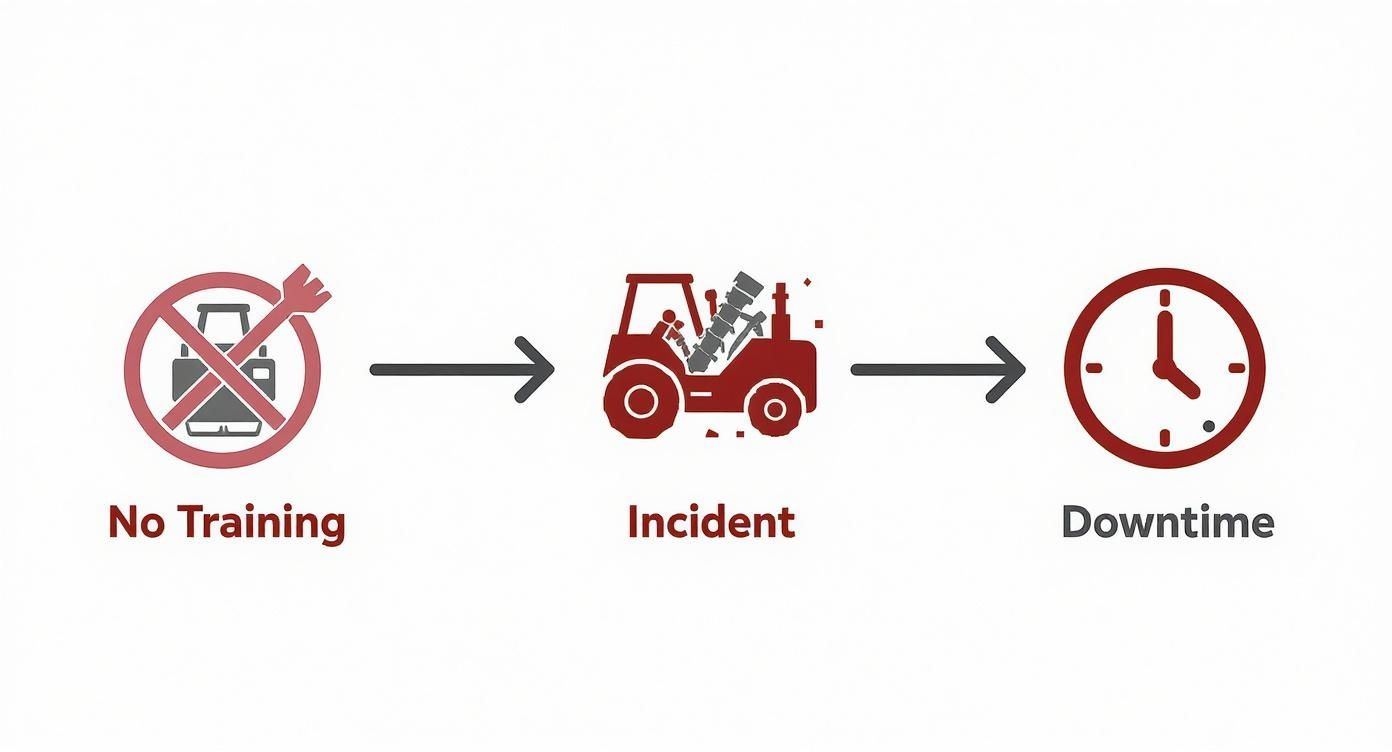
As you can see, skipping training isn't a shortcut. It's a guaranteed path to incidents, injuries, and expensive downtime. A solid, compliant training program is the best defense you have against this predictable chain reaction.
Building a Training Curriculum That Sticks
A truly effective program does more than just check boxes; it builds competence and instinct. A great forklift operator safety training curriculum is one where operators don't just memorize facts for a test, but internalize safe habits that become second nature on every single shift. Let's walk through how to build a program that actually sticks.
The goal is to move beyond simple compliance and foster a deep, practical understanding of the machine and its environment. This means mapping out everything from the physics of a forklift to the nitty-gritty of a pre-use inspection. If you're looking for a framework, there are some solid best practices on how to create effective training modules that can help structure your content.
This commitment to quality training isn't just a good idea—it's big business. The global market for forklift operator training was valued at $1.2 billion in 2024 and is expected to hit $2.4 billion by 2033. With North America making up about 35% of that market, it’s clear that strict safety regulations and the demand for certified operators are driving major investment.
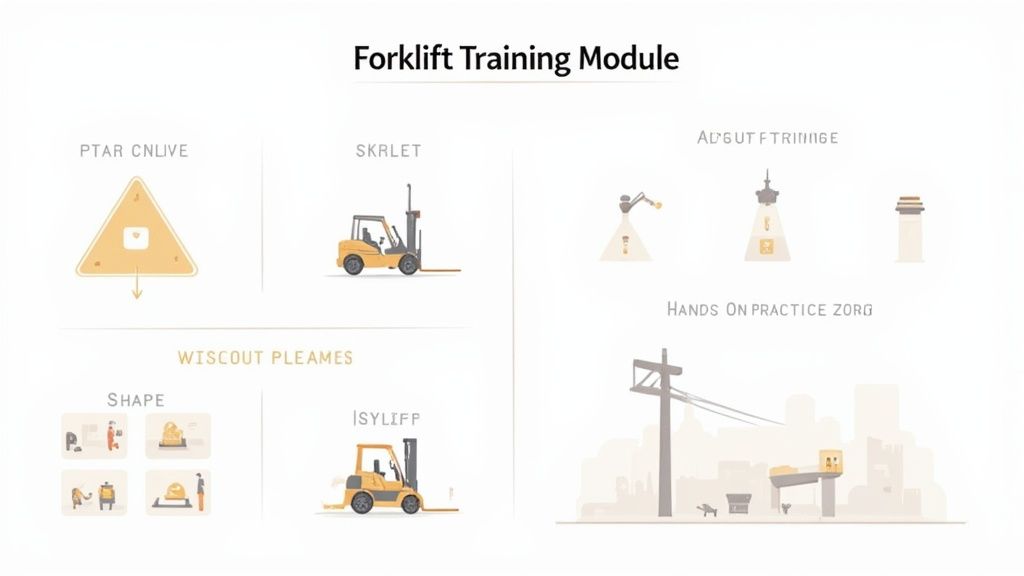
Core Curriculum Components for OSHA Compliance
OSHA is very clear that training must include both formal instruction (the "classroom" part) and practical, hands-on evaluation. Your curriculum needs to be built around these two connected phases, as both are crucial for developing a safe, well-rounded operator.
Here’s a look at the essential topics OSHA requires for each phase.
Core Curriculum Components for OSHA Compliance
| Training Phase | Required Topics and Skills |
|---|---|
| Formal (Classroom) | Vehicle stability (the stability triangle), load capacity, pre-operation inspections, fueling/charging procedures, and truck-specific controls and instrumentation. |
| Practical (Hands-on) | Performing pre-use checks, maneuvering in tight spaces, stacking and unstacking loads, operating on ramps or inclines, and responding to workplace-specific hazards. |
While this table covers the bare minimum, a standout curriculum goes further by tailoring these topics to the specific machines, attachments, and challenges found right in your own facility.
From Theory to Practice With Real-World Scenarios
Book smarts are one thing, but the real learning happens when operators have to apply that knowledge under pressure. Generic exercises are a decent starting point, but creating scenarios that mirror the unique chaos of your own facility is what truly makes training effective.
Forget just driving around cones in an empty parking lot. Design exercises that force trainees to think on their feet.
- Navigating with an Offset Load: Give the operator an awkwardly balanced load (safely, of course). This forces them to feel how it impacts the machine's stability and adjust their speed and turns accordingly.
- Operating on an Incline: Set up a ramp and have them practice moving up and down, both with and without a load. This hammers home the critical rule: forks always point uphill.
- The "Blind Corner" Test: Simulate a busy intersection in your warehouse. The operator must approach the corner, stop, honk, and then proceed with caution, just as they would when pedestrians are nearby.
These practical exercises bridge the gap between knowing a rule and having the muscle memory to apply it automatically.
The best hands-on training feels less like a test and more like a dress rehearsal for a typical workday. It builds instinct and decision-making skills that are impossible to learn from a textbook.
Embracing Technology to Enhance Learning
Modern tools can add powerful new dimensions to your training program. While nothing can ever fully replace time on a real machine, technology offers incredibly safe and effective ways to supplement your curriculum.
Virtual Reality (VR) simulators are one of the most exciting tools available today. These systems allow new operators to experience a huge range of scenarios—from routine stacking to full-blown emergencies—in a completely safe, controlled digital environment.
Think about it: a VR simulator lets a trainee make a critical mistake, like turning too fast with a raised load, and see the consequences of a tip-over without any real-world risk. That's an invaluable lesson that would be impossible and dangerous to replicate in a live training session.
By combining solid classroom learning, realistic hands-on scenarios, and innovative tools like VR, you can build a curriculum that does more than just certify operators—it creates safer, more competent, and more confident members of your team.
Finding the Right Trainer and Training Format
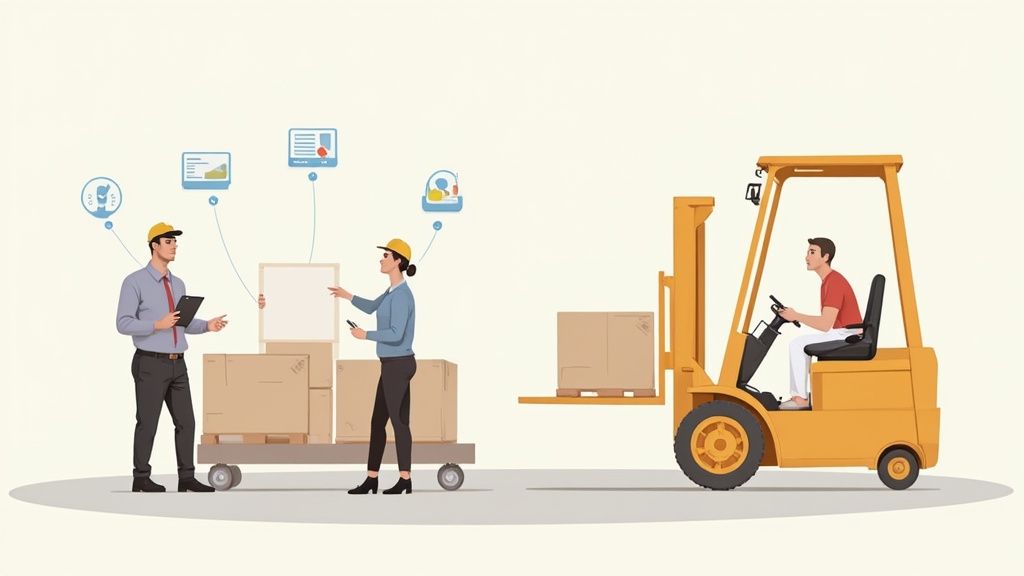
The person leading your forklift operator safety training can make or break the whole program. A great instructor doesn't just check a box; they build real competence and confidence. The difference isn't just about how many years they've spent behind the wheel. It's about a deep understanding of the regulations and the ability to explain complex safety ideas in a way that sticks.
Whether you're training an in-house expert or bringing in a third party, the core qualifications are the same. You need someone who knows not just how to operate a forklift, but why the rules exist in the first place. They're the ones who can connect the physics of the stability triangle to a real-world story about a near-miss they witnessed years ago.
That ability to turn dry regulations into memorable, practical lessons is what separates a true safety leader from someone just reading slides.
What to Look for in a Forklift Trainer
OSHA's language is a bit vague, stating trainers must have the "knowledge, training, and experience" to be effective. But what does that actually look like on the warehouse floor? It boils down to a mix of hard skills and the ability to connect with people.
Here’s what you should be looking for in a qualified instructor:
- Verifiable Experience: They need serious hands-on time operating the same types of powered industrial trucks your crew uses daily.
- Deep OSHA Knowledge: A good trainer can explain the relevant parts of the 29 CFR 1910.178 standard without fumbling for their notes.
- Effective Communication Skills: They have to be patient and clear, able to adjust their teaching style for brand-new operators and seasoned veterans alike.
- Ability to Evaluate: They need the confidence and expertise to accurately assess an operator's skills and give constructive feedback that actually helps them improve.
A skilled operator doesn't automatically make a skilled trainer. The best instructors are those who can not only perform the job flawlessly but can also break down every action and explain the 'why' behind it to someone seeing it for the first time.
If you're building an internal program, investing in a "train-the-trainer" course is a fantastic move. For companies that need external help, learning about our approach to safety and compliance can give you a solid benchmark for what a professional partner should deliver.
Choosing the Right Training Delivery Method
How you deliver the training is just as critical as who delivers it. A one-size-fits-all program rarely works because your operators will have different experience levels and learning styles. The best programs usually mix and match different methods to cover all the bases.
Let's break down the common formats.
| Training Format | Pros | Cons |
|---|---|---|
| Traditional Classroom | Highly interactive, lets people ask questions immediately, and builds team cohesion. | Can be a headache to schedule, needs a dedicated physical space, and can feel slow for some learners. |
| Online Learning | Flexible and self-paced, delivers consistent information, and is great for the theoretical side of things. | Can't satisfy OSHA's hands-on requirement alone, feels isolating, and has limited interaction. |
| On-the-Job Training | Uses the exact equipment and environment your operators will work in every day. | Can disrupt operations, might pass on bad habits if the trainer isn't on top of their game, and is often unstructured. |
Blended Learning The Modern Standard
For most operations today, a blended learning approach is the clear winner. This strategy combines the best of all worlds to create a training experience that's far more effective and engaging for your team.
Typically, this means using self-paced online modules to cover the formal instruction—the "book smarts." Operators can learn the rules, physics, and safety protocols on their own time. Then, they move on to in-person, hands-on sessions where a qualified instructor can watch them apply that knowledge on the actual equipment.
This combined approach ensures operators don’t just memorize answers to pass a test. They actually master the skills needed to work safely and productively day in and day out.
Mastering Your Documentation and Record-Keeping
When an OSHA inspector walks through your door, the first thing they'll want to see is your training documentation. In their world, if it isn't documented, it never happened.
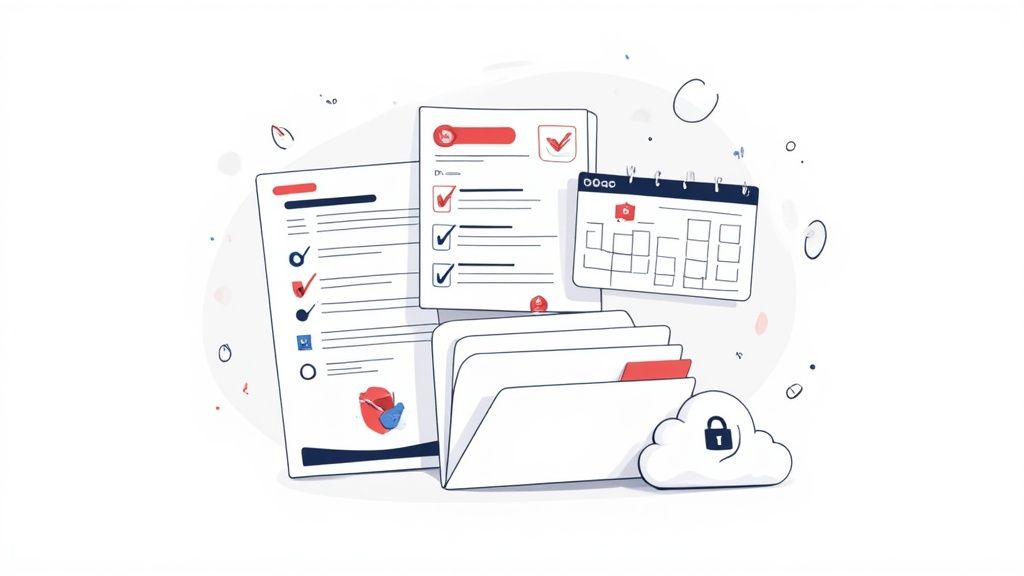
This isn't just about shuffling papers. Meticulous record-keeping is your single best defense during an audit. It’s the official story of each operator's journey from trainee to a certified professional, and it's proof of your commitment to a safe workplace. Getting this right protects your business and shows your team you take safety seriously.
Creating Audit-Proof Training Records
The goal is to have a complete, organized, and easily accessible training file for every single operator. A rushed or incomplete file can make an otherwise perfect forklift operator safety training program look non-compliant in an instant.
At a minimum, your documentation for each forklift operator must include:
- The Operator's Name: Use their full legal name to avoid any mix-ups.
- Dates of Training: List the specific dates for both the classroom and the hands-on training sessions.
- Date of Evaluation: This is the exact date the operator passed their final practical assessment.
- Identity of the Trainer(s): The full name and job title of the person (or people) who conducted the training and the final evaluation.
This is the bedrock of the operator's certification. Make sure it’s all clear, accurate, and legible.
Essential Documents for Your Files
Strong documentation goes beyond just the initial certification. It includes the daily records that show safety isn't a one-time event, but an ongoing part of your culture.
Two documents are absolutely critical here:
- Daily Forklift Inspection Checklists: OSHA mandates pre-shift inspections. Keeping these completed checklists is your proof that these vital safety checks are actually happening. It's also how you catch small maintenance issues before they turn into big accidents.
- Operator Evaluation Forms: Don't just check a box that says "passed." The evaluation form should detail every skill you assessed—like stacking, navigating ramps, or performing a proper shutdown—and how the operator performed on each task.
These daily records provide the tangible evidence that your safety program is alive and well every single day.
In an audit, your records speak for you before you even say a word. Well-organized, complete documentation tells an inspector volumes about your company's dedication to safety.
Storage and Retention Best Practices
How you store your records is just as critical as what you put in them. You need a system that's both secure and easy to access when you need it. Let's be honest, digging through a dusty filing cabinet during an inspection is not a good look.
This is why so many companies are moving to digital systems. Imagine a secure, cloud-based folder for each operator. You can scan and store their certification, evaluation forms, and even photos of their completed driving tests. This protects the records from being lost in a fire or flood and lets you pull them up in seconds.
For operations looking to get even smarter, new technologies can make this process seamless. For example, understanding how QR codes for logistics work can be a game-changer. A simple QR code slapped on a forklift could link directly to its digital inspection and maintenance log, giving anyone immediate access to its safety history.
Whether you go digital, stick with physical files, or use a mix of both, the key is consistency. OSHA requires you to keep certification records for the entire time an operator is employed with you. By getting your documentation right, you build a resilient, defensible safety program that genuinely protects your people and your business.
Answering Your Top Forklift Training Questions
Even with OSHA's rulebook in front of you, a lot of confusion still swirls around forklift operator safety training. It’s easy to get bogged down in the details, but getting clear, direct answers is the only way to build a program that's truly compliant and keeps your people safe.
Let's cut through the noise and tackle the questions we hear most often. Getting these details right is critical—small misunderstandings can create major compliance gaps, putting both your operators and your business at risk.
How Often Does a Forklift Operator Need Recertification?
This is easily one of the most misunderstood parts of the standard. The official OSHA rule, 1910.178(l)(4), states that an operator's performance must be evaluated at least once every three years.
But here’s the trap: thinking of it as a simple three-year cycle is a huge mistake. That's the absolute minimum under perfect conditions. In the real world, refresher training and a new evaluation are needed much sooner if certain things happen.
Your operator needs immediate retraining if they:
- Are involved in an accident or even a near-miss.
- Are spotted operating the forklift unsafely.
- Receive a poor evaluation during a routine check.
- Are assigned to a different type of truck or a new attachment.
- Work in an area where the environment changes, like new racking or different pedestrian routes.
Think of certification less like a driver's license that's good for three years and more like a continuous verification. The second an operator's performance or their work environment changes, their training needs to catch up.
Can All Forklift Training Be Done Online?
Not a chance. While online modules can be a great, efficient way to handle the formal "classroom" part of the training, a 100% online program will never be OSHA-compliant.
This is a critical point that trips up a lot of companies, often lured in by providers selling misleading "online OSHA certifications."
OSHA is crystal clear on this: training must include a hands-on, practical component. This means demonstrations from a qualified trainer and exercises performed by the trainee on the exact type of equipment they'll be using for their job.
The final, non-negotiable piece is an in-person evaluation. A trainer has to physically watch the operator drive the forklift in their actual work environment to sign off on their skills. Any program that skips this hands-on proof is leaving your company completely exposed.
Who Is Qualified to Be a Forklift Trainer?
OSHA doesn't hand out "forklift trainer" licenses. Instead, the responsibility falls squarely on you, the employer, to make sure the person leading the training is actually qualified.
The standard says a trainer must have the necessary knowledge, training, and experience to train and evaluate operators. So, what does that look like in practice?
- Deep Experience: They should have plenty of hours operating the same class of forklifts your team uses. You can't teach what you haven't done.
- Regulatory Smarts: They need a rock-solid understanding of the OSHA 1910.178 standard and be able to explain it to others.
- Good Communication Skills: Being a great operator doesn't automatically make someone a great teacher. They need to be able to explain concepts clearly, give constructive feedback, and guide trainees patiently.
Many companies handle this by promoting a senior, safety-focused supervisor into the role. Others send a key employee to a "train-the-trainer" course to build those instructional skills. Hiring a reputable third-party training provider is also a popular and effective route.
Is a Forklift Certification Transferable to a New Job?
Nope. Forklift certifications are not portable. A certificate from Company A is not valid at Company B.
Why? Because OSHA’s rules are designed to be site-specific. The certification must address the unique equipment, attachments, and hazards of each individual workplace.
When an experienced operator joins your team, you are still legally required to evaluate their skills and train them on your specific environment and machinery. Even if they have two decades of experience, you have to conduct your own evaluation and formally certify that they are competent to work safely in your facility, on your equipment.
A new hire's prior experience is definitely a plus—it can make the training process much faster. But it absolutely does not remove your responsibility to verify and document their skills yourself.
Ready to build an OSHA-compliant program that sticks? At Flat Earth Equipment, we provide comprehensive, bilingual forklift training solutions that blend engaging online learning with practical, hands-on verification. Ensure your team is certified correctly and your business is protected. Explore our OSHA-compliant forklift operator safety training today!