A 36V golf cart battery charger is a lot more than just a power cord. It’s the life-support system for a damn expensive battery pack. The right smart charger is what stands between you and a dead fleet from problems like sulfation, keeping your gear moving and out of the shop.
Why Your 36V Charger Matters More Than You Think
Out in the field, uptime is king. When a piece of yellow iron goes down, it’s not just an annoyance—it’s money bleeding out of your pocket. The story’s the same whether it’s a JCB telehandler stuck in another cursed regen cycle or a golf cart that won’t take a charge. The dealership wants you to haul it in, hook it up to their proprietary laptop, and wait. That ain’t how we do things.
The lifeblood of your 36V cart fleet is its charging system. Treating a charger like some generic box with a plug is a rookie mistake. It’s your first and best line of defense against the slow, silent killers of lead-acid batteries: sulfation, undercharging, and overcharging. A cheap, "dumb" charger just force-feeds power into the batteries until a timer dings, boiling away the electrolyte and cooking the plates like a bad steak.
The Real Cost of a Bad Charger
A modern, multi-stage 36V golf cart battery charger is smarter than that. It actually talks to your batteries. It senses their state of charge, temperature, and internal resistance, then dials its output to deliver a precise, healthy charge. This isn't just about fancy electronics; it's what separates a battery pack that dies in two years from one that gives you five or more years of hard service.
The right charger is a tool, not an accessory. It actively works to protect your investment, extend battery cycle life, and keep your carts rolling. Neglecting it is like running an engine without changing the oil—failure is guaranteed, and it will be expensive.
This is especially true when you see how many of these systems are out there. In the ever-expanding golf cart battery market, the 36V electric drive segment is the undisputed leader, projected to command a massive 55% revenue share in 2025. These batteries are the backbone of fleets everywhere, which makes taking care of them non-negotiable. For a deeper dive into these market trends, you can review the full analysis from Future Market Insights.
36V Charger Impact At-A-Glance
The difference between an old-school fire hazard and a modern smart unit isn't subtle. It shows up in your maintenance logs, your budget, and your daily headaches. Here's a quick breakdown of what to expect.
| Metric | Standard (Old-School) Charger | Smart Charger (Modern Tech) |
|---|---|---|
| Battery Lifespan | 2-3 years (typical) | 5+ years (common) |
| Charging Method | Bulk charge only; high risk of over/undercharging | Multi-stage algorithm (bulk, absorption, float) |
| Efficiency | Lower (wastes electricity as heat) | Higher (saves on utility bills) |
| Maintenance Needs | Frequent water level checks (due to boiling) | Minimal; maintains battery health automatically |
| Diagnostic Info | None (just on/off) | LED indicators for charge status, faults, battery health |
| Long-Term Cost | High (frequent battery replacements, downtime) | Low (protects battery investment, reduces downtime) |
Simply put, investing in a quality smart charger pays for itself by keeping your most expensive wear item—the battery pack—alive and kicking for as long as possible.
Uptime Starts with Smarter Charging
At the end of the day, a quality charger saves you from the biggest headaches in fleet management:
- Reduced Replacement Costs: By maximizing the number of charge cycles you get from a battery pack, you push off that thousand-dollar replacement bill for years.
- Eliminated Downtime: Properly charged batteries deliver consistent power and predictable runtimes, preventing carts from dying mid-shift.
- Less Time Troubleshooting: A smart charger with clear indicators helps you diagnose problems faster. You'll know if it's a bad battery or just a loose connection.
Instead of fighting with your equipment, you can focus on the job. We know the frustration of being locked out by the dealer's laptop and their proprietary tools. That’s why we believe in giving techs the parts and the knowledge they need to fix things themselves. Flat Earth Equipment's handpicked selection of high-quality battery chargers is built for people who demand reliability without the dealer runaround.
Matching Your Charger to the Battery Chemistry
Anyone who's ever turned a wrench knows you don’t put diesel in a DEF tank or hydraulic fluid where engine oil goes. That’s a fast way to turn a working machine into a very expensive paperweight. It’s the exact same principle with your golf cart batteries. Using the wrong charging profile for your battery chemistry isn’t just a simple mistake; it’s an expensive failure waiting to happen.
A battery charger for golf carts 36v is not a one-size-fits-all device. The three main battery types you'll run into—traditional flooded lead-acid, sealed AGM, and modern LiFePO4 (lithium iron phosphate)—all have completely different appetites for electricity. Trying to force-feed one the wrong diet will wreck a battery pack faster than a new operator finding a hidden curb at full speed.
Why Charging Profiles Are Not Optional
Think of a charging profile as a specific recipe for electricity. A classic flooded lead-acid battery needs a multi-stage charge that includes a special "equalization" phase. This is basically a controlled overcharge that gently "boils" the electrolyte, mixing up the stratified acid and knocking stubborn sulfate crystals off the lead plates. It’s a vital maintenance step that keeps the battery healthy. It's like a forced regen cycle, but one that actually works.
But here’s the kicker: if you hit a sealed AGM or a lithium battery with that same equalization charge, you’ll destroy it. An AGM battery can't handle the high voltage and will vent gas, drying out its internal mat for good. Subject a lithium battery to that kind of overvoltage, and you risk thermal runaway—a catastrophic and incredibly dangerous failure.
Every battery chemistry has a unique voltage and current requirement. Matching the charger's profile to the battery isn't just a best practice; it's a fundamental requirement for safety and getting the lifespan you paid for.
Fleet operators and seasoned techs know that reliable battery chargers for 36V golf carts are non-negotiable. This is especially true with lead-acid batteries, which still hold 67.3% market share in 2024 and demand precise charging to hit their 300-500 cycle lifespan. The entire golf cart battery market, valued at USD 145.1 million in 2024, is built on this principle of matching the right tool to the right job. You can get more insights on the growing demand for proper battery care from Market.us.
A smart charger directly impacts uptime, battery life, and your bottom line.
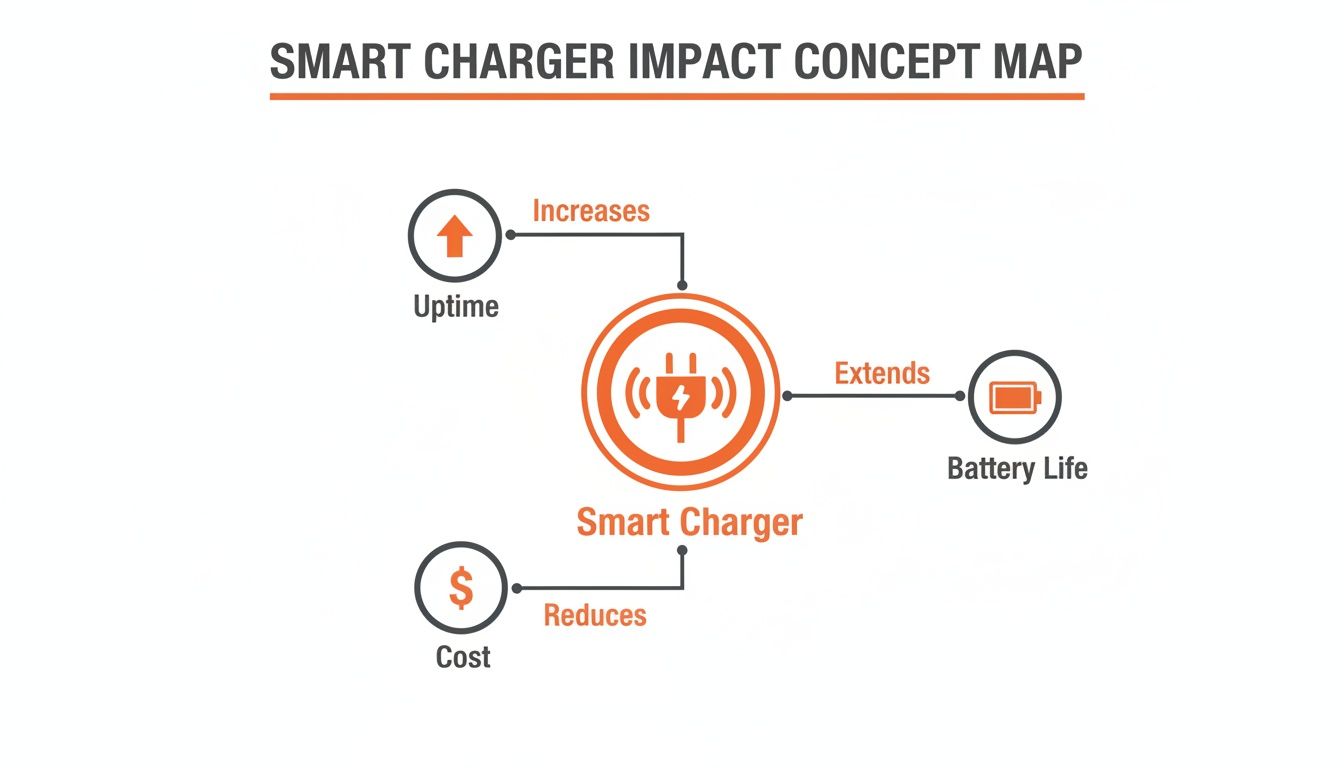
As you can see, the right charger creates a positive feedback loop: better charging leads to longer life, which cuts replacement costs and keeps your carts out there working instead of sitting in the shop.
The Three Main Battery Chemistries
Let's break down the charging needs for each type you'll find out in the wild.
1. Flooded Lead-Acid (FLA)
These are the old-school, tried-and-true workhorses. They're tough as nails but demand regular maintenance, which means topping off the water levels. Don't be lazy.
- Charging Needs: Requires a multi-stage charging algorithm (Bulk, Absorption, Float) plus a periodic Equalization cycle to fight sulfation.
- Technician's Tip: Never, ever let these sit dead. Sulfation starts immediately and hardens over time, permanently choking off the battery's capacity like a clogged fuel filter.
2. Absorbent Glass Mat (AGM)
AGM batteries are a type of sealed lead-acid battery. Since the electrolyte is absorbed in fiberglass mats, they're maintenance-free—no watering.
- Charging Needs: They are extremely sensitive to overcharging. A smart charger with a specific AGM profile is non-negotiable. They do not get an equalization phase. Ever.
- Technician's Tip: Hooking one of these up to a standard lead-acid charger without a dedicated AGM setting will kill it fast. It's like putting the wrong hydraulic filter on a JCB—it might fit, but it's going to cause expensive problems.
3. Lithium Iron Phosphate (LiFePO4)
This is the new kid on the block. Lithium batteries are lighter, last way longer, and are maintenance-free, but they have very strict charging requirements managed by an internal Battery Management System (BMS).
- Charging Needs: Requires a specific CC/CV (Constant Current/Constant Voltage) profile. The charger must be designed for lithium chemistry so it can communicate properly with the BMS.
- Technician's Tip: Do not attempt to use a lead-acid charger on a lithium battery. Even if it seems to work, you're bypassing the critical safety features of the BMS and can cause irreversible damage or create a serious fire hazard. It's a stupid risk. Don't take it.
Sizing Your Charger: Amps vs. Ah Explained
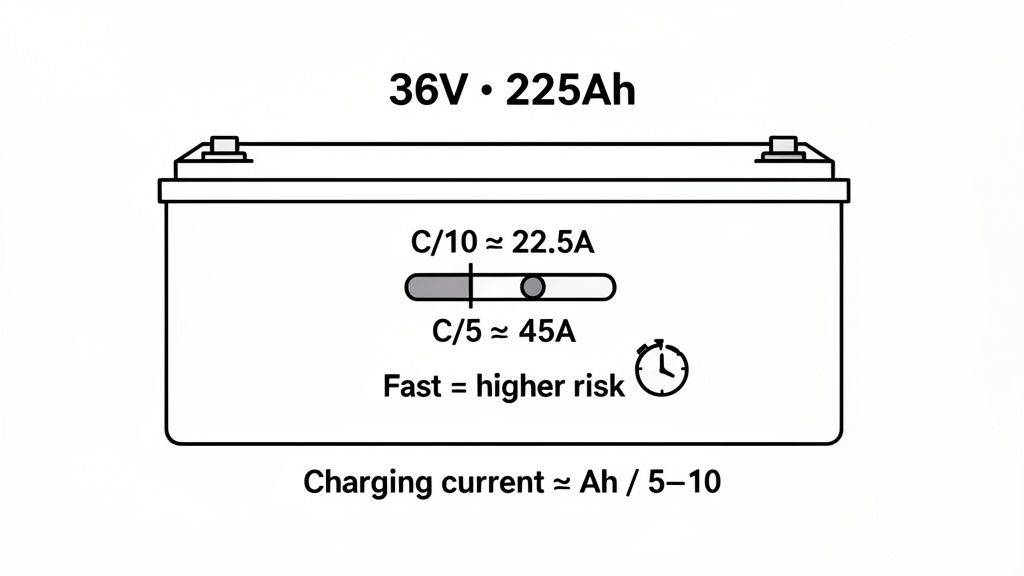
This is where a lot of guys go wrong, and it costs them. Picking the right amperage for your 36V golf cart battery charger is a balancing act—one that determines whether you get a quick, healthy charge or just slowly boil your expensive battery pack into an early grave.
Think of it like this: your battery's amp-hours (Ah) is the size of the fuel tank, and the charger's amperage (Amps or A) is the speed of the pump.
If you go too low on amps, your carts will be stuck at the wall forever, which is a productivity killer. It’s like trying to fill a telehandler's diesel tank with a 5-gallon can. But if you go too high, you create a ton of heat, boil off the electrolyte in your lead-acid batteries, and permanently damage the internal plates. It's the fastest way to kill a battery, guaranteed.
Finding the Sweet Spot
The goal isn't just charging fast; it's charging smart. For traditional flooded lead-acid and AGM batteries, the sweet spot for charging amps is right between 10% and 20% of the battery pack's total Amp-hour (Ah) rating. This range is the perfect middle ground between charging speed and battery health. Pushing it faster than that on a regular basis is just asking for a breakdown.
Let's break it down with a standard 225Ah 36V golf cart battery pack, which you'll find everywhere.
- 10% (Focused on Longevity): 225Ah x 0.10 = 22.5 Amps
- 20% (Focused on Speed): 225Ah x 0.20 = 45 Amps
So for a typical 225Ah pack, any charger between 22A and 45A is in the safe zone. A 25A charger will be gentle on the batteries and help you squeeze every last cycle out of them. A 35A or 40A charger gets the job done much faster without creeping into the danger zone. Anything over 45A is just putting unnecessary stress on the pack for daily charging.
Tech's Rule of Thumb: A quick way to find the ideal amperage is to calculate 15% of your pack's Ah rating. This gives you a great mix of speed and battery care. For a 225Ah pack, that's about 34 amps—making a 35-amp charger a nearly perfect match.
Real-World Application and Trade-Offs
What does this look like out in the dirt? A lower-amp charger, say 20A, might take 8-10 hours to fully recharge a deeply drained 225Ah pack. A higher-amp charger, like a 40A unit, could slash that time to 5-6 hours.
For a commercial fleet that needs a quick turnaround between shifts, that speed is mighty tempting. But it comes at a cost: more heat, more gassing, and more wear and tear on the battery plates over time.
For most operations, hitting that middle ground is the winning strategy. It's why a quality smart charger like the Green4 36V 35A is such a popular choice for standard packs. It delivers a fast, efficient charge without abusing the batteries.
Sizing for Lithium Batteries
Now, when you switch to LiFePO4 (lithium), the game changes. Lithium batteries can handle much, much higher charge rates. Many can be charged at a 1C rate, which means you could theoretically charge a 100Ah battery with a 100A charger.
But just because you can doesn't mean you should.
Even with lithium, charging at a more moderate rate like 0.5C (a 50A charger for a 100Ah battery) is far healthier for the cells. It will extend the battery's already impressive lifespan even further. The most important thing is to always check the battery manufacturer's spec sheet. Their recommended maximum charge rate is an absolute ceiling, not a daily target.
A Field Guide to Connectors, Wiring, and Installation

A brand-new 36V golf cart battery charger is just an expensive paperweight if you can't plug it in. This is where the real work begins—out in the shop, with wrenches in hand. A bad connection is just like a faulty sensor on a JCB backhoe; it stops the whole machine dead and sends you chasing problems that aren't there.
Getting the plug and wiring right is the difference between a cart that works every morning and one that’s a constant headache. Forget waiting on the dealer to fix melted plugs and intermittent charging. Those problems all start with a sloppy connection. We’ll walk through the common connectors, how to wire them safely, and how to install your charger so it lasts.
Identifying Your Connector Plug
Before you can even think about charging, you have to know what you’re looking at. Different cart manufacturers used different plugs over the years, and grabbing the wrong one is a quick way to waste time and money.
Here's a quick rundown of the most common connectors you'll encounter on 36V systems.
Common 36V Golf Cart Charger Connectors
This table is your quick visual guide to identifying the plug on your cart. Match the description to what you see, and you'll know exactly what you're working with.
| Connector Name | Visual Description | Commonly Found On |
|---|---|---|
| Crowfoot Plug | An older, two-pin rectangular plug. | Vintage Club Car models |
| EZ-GO 'D' Plug | Shaped like a capital 'D' with two recessed round pins. | Many older 36V EZ-GO carts |
| Club Car Round Plug | A 3-pin round connector providing a secure, positive lock. | Many Club Car models |
| Anderson SB-50 | A gray, genderless two-pole connector. | Custom builds & heavy-duty applications |
Getting the plug right is non-negotiable, especially when replacing an old charger. If you're trying to find a replacement for an older EZ-GO, for instance, you have to make sure it comes with the correct D-style plug. A direct-fit unit like a PowerWise 36V EZGO charger can save you from cutting wires and creating compatibility headaches.
Key Takeaway: A loose or corroded connector creates high resistance. Resistance generates heat, and heat melts plastic, destroys terminals, and can easily start a fire. A clean, tight connection isn't just a suggestion—it's essential for safety and performance.
Onboard vs. Portable Charger Wiring
How you wire your charger depends entirely on where it lives. The rules for a charger bolted to the cart are very different from one mounted on the shop wall.
Onboard Charger Installation
An onboard charger has to endure constant vibration, dust, and moisture. Securing it properly is everything.
- Mounting: Bolt the charger securely to the cart's frame, not a flimsy plastic body panel that can crack. Use rubber grommets or vibration dampeners to absorb shock and extend the unit's life.
- Wire Gauge: Use the wire gauge recommended by the manufacturer, which is typically 10 AWG or thicker for the DC cables running to the battery pack. Undersized wires will get dangerously hot.
- Fuse Protection: Always install an inline fuse on the positive DC cable, placing it as close to the battery pack as possible. This is your number one defense against a dead short.
- Cable Routing: Run your wires away from sharp metal edges, moving parts, and hot components like the motor. Use protective loom and zip ties to prevent wires from chafing over time.
Portable (Shore) Charger Setup
With a portable charger that stays in one place, the focus shifts to the AC power supply and proper cord management.
- Dedicated Circuit: High-amperage chargers pull a lot of power. They should have their own dedicated 20A circuit to avoid constantly tripping the shop's breakers.
- Cord Care: Never unplug the charger by yanking the DC cord from the cart. This puts stress on the pins inside the plug and the cart’s receptacle, leading to poor connections and a fire hazard.
- Ventilation: All chargers generate heat. Make sure there’s plenty of airflow around the unit. Pushing it against a wall or covering it with shop rags is a sure way to make it overheat and shut down.
Troubleshooting Common Charger and Battery Failures
When a cart won't charge, the clock starts ticking. Out in the field, this isn’t just an inconvenience; it’s downtime that costs money. Is it the charger? The batteries? Something else? Forget calling the dealer and waiting for a slot. This is your field diagnostic manual to get answers now.
We’re going to walk through a logical, step-by-step process to chase down the most common charging issues. This is all about practical, in-the-dirt troubleshooting to figure out if you have a bad battery charger for golf carts 36v or a battery pack that’s just too dead to wake up.
The First Step: Always Use a Multimeter
Guesswork is for amateurs. The first tool out of your bag should always be a multimeter. It tells you the hard truth about what’s happening with the electricity and will save you from chasing ghosts all afternoon.
Start your diagnosis by checking for voltage. This simple test splits the problem in half immediately.
- At the Wall Outlet: Is the outlet even live? Check for a solid 120V AC. It sounds basic, but a tripped breaker is the easiest fix you'll ever find.
- At the Charger Plug: With the charger plugged into the wall but not the cart, check the DC output at the connector pins. You should see the charger’s rated voltage (somewhere around 36-40V DC). If you get nothing here, the problem is likely inside the charger itself.
- At the Battery Pack: Now, check the total pack voltage across the main positive and negative terminals. This is the single most critical reading you'll take.
Charger Won't Turn On at All
This is the number one complaint we hear. You plug it in, and... nothing. No hum, no click, no lights.
Before you condemn the charger, check that battery pack voltage. Most modern smart chargers have a built-in safety feature that prevents them from turning on if they don't detect a minimum voltage from the pack—usually around 25V for a 36V system.
Technician's Insight: If your battery pack has been sitting for a while and the voltage has sagged below that 25V threshold, the charger will think there's nothing connected. It's not broken; it's just blind. The charger hasn't failed; the batteries have failed the charger's safety check.
Charger Clicks On and Off Repeatedly
If you hear the charger click on, hum for a second, then click right back off, that's a classic symptom. It means the battery pack is hovering right on the edge of that minimum voltage threshold.
The charger sees just enough juice to try and start its cycle, but the initial load causes the pack voltage to droop. The charger's brain sees the voltage dip below its safety limit and immediately shuts down to protect itself.
This issue is popping up more as fleet managers replace aging equipment. The aftermarket demand for 36V golf cart chargers reflects a bigger trend, with one market analysis forecasting a 5.4% CAGR from 2025-2034 as facilities ditch old lead-acid systems. These new, advanced chargers extend battery life by up to 25% with features like anti-overcharge protection, but their safety lockouts can confuse technicians used to older, simpler units. You can learn more about these golf cart battery market findings and see why smart charging is becoming the new standard.
Common Failure Points and How to Test Them
If you've confirmed the battery pack has enough voltage (above 25V), but the charger still won’t cooperate, here's where to look next.
1. The Charger Receptacle
The port on the cart takes a ton of abuse. Vibration, moisture, and constant plugging and unplugging eventually take their toll.
- Visual Inspection: Look for corroded pins, melted plastic around the terminals, or loose wires on the back of the receptacle.
- Wiggle Test: With the charger plugged in, gently wiggle the plug. If the charger's lights flicker or it tries to kick on, you've found your bad connection.
2. The DC Cord
Check the entire length of the DC cord from the charger box to the plug. Look for any cuts, frays, or obvious damage. An internal break in the wire can stop it dead in its tracks.
3. Fuses
Some chargers have an external or internal fuse. Check your charger’s manual to see if it has a user-serviceable fuse and test its continuity with your multimeter.
By following this logical sequence—outlet, charger output, pack voltage, and physical connections—you can diagnose over 90% of charging problems in minutes, without ever having to haul the cart back to the shop.
What Advanced Features Actually Matter?
Modern chargers are often loaded with bells and whistles, but out in the field, half that stuff is just marketing fluff. It reminds me of a dealer telling you a new JCB needs a laptop hookup just to read a simple fault code. We’re not interested in features that don’t solve real-world problems. We want the tech that keeps a machine running, period.
When it comes to a 36V golf cart battery charger, there are a handful of features that genuinely make the difference between a healthy, long-lasting battery pack and a dead one. These are the tools that fight back against the slow, silent death of your batteries, extending their life and saving you a trip to the parts counter.
Temperature Compensation: A Non-Negotiable Feature
This is the big one. A temperature compensation sensor is a small probe that reads the ambient temperature right at your batteries and tells the charger to adjust its voltage accordingly. Why does this matter so much? Because a battery’s charging needs change dramatically with the weather.
Trying to charge a cold lead-acid battery at a voltage set for a warm day will consistently undercharge it, leading to a nasty buildup of sulfation. On the flip side, charging a hot battery at that same voltage will overcharge it, boiling the electrolyte and wrecking the plates for good.
Think of it this way: a charger without temperature compensation is just guessing. A charger with it is making a precise, calculated adjustment every single time. It’s the single most important feature for maximizing battery life in any environment that isn't climate-controlled.
This isn’t just a convenience; it’s about protecting a thousand-dollar investment from getting cooked or frozen into an early grave by seasonal temperature swings.
Smart Charging Profiles That Get the Job Done
Beyond just temperature, a smart charger uses multi-stage charging profiles to treat your batteries right. Forget the old-school "dumb" chargers that just blast power until a timer goes off. A proper smart charger follows a specific, proven recipe.
- Bulk Stage: This is the workhorse phase, pushing the majority of the charge (around 80%) into the batteries at a constant amperage.
- Absorption Stage: As the battery nears full, the charger holds the voltage steady and tapers the current down. This lets the plates fully absorb the charge without overheating.
- Float/Maintenance Stage: Once the battery is topped off, the voltage drops to a low, gentle level—just enough to counteract self-discharge. This keeps the battery ready to go for weeks or even months of storage without slowly cooking it.
This automated process is what prevents the most common battery-killing mistakes. A good charger with these profiles, plus a maintenance mode, ensures your carts are ready to go when you are, whether that's tomorrow or next season. While features like data logging can be useful for massive fleets, for most operations, a solid multi-stage profile combined with temperature compensation is the winning ticket.
Your 36V Golf Cart Charger Questions Answered
Out in the field, you don't have time for corporate doublespeak or a trip to the dealer. You need straight answers to get a machine running again. Here are the questions we hear all the time from techs in the dirt, answered with practical advice, not a sales pitch.
Can I Use A 48V Charger On My 36V Golf Cart?
Absolutely not. Don’t even think about it. This is a fire hazard, plain and simple, and it will destroy your 36V battery pack.
You're trying to force far too much electrical pressure (voltage) into a system that was never designed to handle it. Think of it like trying to fill a bicycle tire with an industrial air compressor—something is going to explode, and it won't be pretty. This will cause severe overheating, dangerous gassing, and permanent battery damage. You’ll cook the plates and likely warp the battery cases.
Always match the charger voltage to the nominal voltage of your battery pack. A battery charger for golf carts 36v for a 36V system, period. No exceptions.
Why Won't My New Smart Charger Turn On?
This is the single most common call we get, and it’s almost always a safety feature, not a broken charger. Most modern smart chargers are designed to be idiot-proof. They need to detect a minimum voltage from the battery pack—usually around 25-30V for a 36V system—before they will even consider sending power.
If your batteries are completely dead and the pack's total voltage has fallen below that threshold, the charger’s brain won't "see" them. It stays off to prevent charging a potentially damaged, shorted, or dangerously imbalanced pack. It’s not a failure; it’s a self-preservation instinct built into the electronics, like a JCB that won't start a regen cycle with a clogged sensor.
The fix? You need to "wake up" the pack. Your best bet is to use an old-school manual charger that isn't so clever. You can also individually charge each 6V or 12V battery in the series to bring the total pack voltage up to a level the smart charger can finally recognize.
Do I Need An Onboard Or A Portable Charger?
This really comes down to your operation and how you work. There’s no single right answer, only what’s practical for your setup.
Onboard Chargers: These are bolted directly to the cart. They’re convenient as hell—all you need is an extension cord. This setup is great for fleets where carts are parked and charged in various locations, or for a personal cart where simplicity is key. The biggest downside is their constant exposure to vibration, dirt, and the elements, which can shorten their lifespan.
Portable Chargers: These are standalone "lunchbox" style units, often mounted on a wall in a central charging bay. They are typically more powerful, more durable, and built for heavy-duty, repetitive use. They're the go-to for a dedicated charging station where an entire fleet returns at the end of the day.
For a single personal cart, an onboard unit usually wins on convenience. For a large commercial fleet that needs rock-solid reliability and a central charging point, heavy-duty portable chargers are the way to go.
When you're tired of chasing finicky electronics and just need parts that work, Flat Earth Equipment has the technician-approved chargers and components to get your fleet back on the job. Skip the dealer laptop and get reliable parts shipped fast from https://flatearthequipment.com.